Vend10: Year Two — Get Noticed

In the second installment of the comprehensive history of Vend (glossing over the boring stuff) I asked Nick — Vend employee #1 to tell tales of getting noticed. Nick spent the first couple of years responding to all the support tickets I didn’t have time to, and in the meantime started what was to become the Vend Marketing team. Nick was pivotal in our success as a scrappy startup and our team quickly grew behind him. Nick also has a wicked sense of humour which helped shape our culture (which we will cover next week with another special guest). But I’ll let Nick tell the stories… over to you Nick
If you’ve never seen the first follower lesson in leadership, you could watch it and skip the rest of this article, because it pretty much describes my first year at Vend. So when Vaughan started writing a series about 10 years at Vend, and asked if I’d like to follow his first post, of course I said yes.
I joined at the start of 2011, but since the subject of this blog is ‘getting noticed’ my journey really started in late 2010, when Vend got noticed… by me.
I heard about Vend in the Xero customer newsletter. I knew right away the company would be game changing. My first job in IT, back in the late 90s was for a DOS based POS company in the UK. In 2009, I installed a clunky windows POS system for my brother’s retail store in Auckland. It cost $50K for a single location — we even had to stump up for a head office server, and dump it in the broom closet. The whole retail tech industry was a dumpster fire, ripe for disruption.
And disruption was coming to small business tech. Cloud apps like Xero, Shopify, and Mailchimp were user friendly, for a low monthly fee, and talked to each other through APIs. But more than that, customers loved them. Beautiful accounting software. An email marketing monkey. Who knew business brands could be this fun?
So I had to get on board with Vend. I actually got my intro to Vaughan through Rowan Simpson. After a decade in the UK, when I moved home I wrote a blog called Kiwianarama, which was catharsis for everything that annoyed me about living back in New Zealand. Rowan had reblogged one of my posts. I saw that he was an investor in Vend, so I asked for an intro. I met Vaughan, told him I loved what he’s doing and it’s going to be huge but his marketing sucks, and Vaughan said that’s cool but I’m drowning in support tickets so can you help there first, and after I showed up to the office enough times eventually he offered me a job. So kiwi. So startup.
For the first six months Vaughan and I shared a couple of desks and spent every day hunched over a macbook, faces buried in the screen, fingers hammering at the keyboards. Fast, challenging, exciting work. Half time at first, pulling in help here and there from people who actually knew what they were doing. Morgan on Dev Ops. Rowan Oulton on Front End. Our singular mission was to deliver an amazing product and service for a small but fast growing group of customers who seemed to keep popping up all over the world, Australia, US, UK, Onehunga. Answering support tickets quickly, releasing new features, responding to all sales enquiries, and generally give the impression that we were a “proper” global software company. The reality couldn’t be more different, a handful of part timers working out of someone else’s office in the arse of the pacific ocean.
In the second half of 2011 we raised just shy of $1M in a round led by Christoph Janz, who was already at the time (though I didn’t know it), and would go on to be even more of a legend in SaaS. Vaughan and I celebrated by eating pizza for lunch then got back to work. But we soon went full time, and started convincing some of our part-timers and cheersquard to come on board too. We also started hiring properly. I remember interviewing my first helpdesk hire, Mat Lyons, and said that if you’re looking for the kind of company where people goof off around the water cooler, this is probably not for you. It’s pretty intense. We mainly stare at our screens. Vaughan even sends me google chat when he’s sitting right next to me. But it’s awesome. Matt replied “where do I sign up”.
Fuelling the intensity of that first year was an undercurrent of momentum. It was palpable. Every month, we added more customers than the month before. Every week there were enquiries from all over the world, interest from the media, people who wanted to partner with us, or work for us. We were getting noticed. Which is lucky, because there was no marketing strategy, no master plan. In 2011 ‘growth hacking’ was barely an idea, let alone an entire industry. There was just hard work and failing quickly at lots of things in the hope of finding a few things that work. Fortunately some things did.
I should preface that by saying Vend, like any great startup, was gifted by timing and a fair bit of luck. We caught the early tailwinds of a mass demographic shift away from desktop software and into cloud apps. It was also still early on the growth curve of mobile, especially the iPad. But any tailwind attracts competition, and so we had to move fast and be creative. Here are three things we got right.
We ranked well on Google (aka “search marketing”)
In 2011, with a little effort, it wasn’t so hard to get to the top of page one on Google. So we did. It wasn’t hard at first, hijacking a few long tail terms by changing our homepage tagline from “Clever pos for clever stores” to “Clever web-based pos for clever stores”. But each higher value term we went after took a little more effort; iPad POS, Point of sale software, Point of sale system. Every month our rank moved and so did the volume of visitors and signups. We also upped our game in paid spend too, cutting out all the banner ads on iOS kid’s games, tracking ROI, and doubling down on quality.
None of it was rocket science, it just took effort, time and patience. For the first 5 years at Vend more than 90% of our customers came inbound directly through our website, and the majority of those came through Google. Talented people joined Vend, like Francois Bondiguel (who went on to lead growth at Xero, Deputy and now Canva) to expand our capability even further.
We rode on the coattails of others (aka “Partnerships”)
Vend was one of the first apps in the Xero marketplace. About two months after I joined Vend, we also launched an integration with Shopify. It was such a no brainer for small, independent retail. Beautiful cloud apps, connected through APIs, solving omnichannel commerce, cash flow and compliance. A mini ERP at a fraction of the cost.
What started as a solution to a customer problem, turned into a channel to market. Back then Xero and Shopify had between 5,000 and 10,000 customers each (compared to our 100), so it seemed obvious that their customers might be interested in the only POS that connected to both. Turned out they were also great people to work with. We had a few calls, swapped notes on how to grow a startup, and figured we should do something together. We kicked things off by pooling funds and flying a couple of friends up to San Francisco to film some customer stories, and launched a joint retail campaign.
It became a feature of the Vend story in the years ahead, building a compelling proposition with a popular product, and then leveraging the relationship and their brand to get noticed: Apple, PayPal, Square. We became more sophisticated at it over the years, but it all started with a desire to solve customer problems, and, if I’m honest, a little ‘stars in their eyes’ excitement at the chance to work with some of your favorite global tech brands… especially when you get to do it from l’il ole New Zealand. It still motivates me every day in my role leading the app ecosystem at Xero.
We had fun (aka “Brand”)
We also didn’t have a brand strategy, but we were having a lot of fun, and a good brand is really just a window into your culture, so we thought why not open the curtains wide and let everyone see who we were. It wasn’t so much about getting noticed, as it was about reflecting back to our customers something they could see in themselves. Retail is, can be, and should be fun. People love shopping. Our customers were quitting their day jobs in finance to open a brewery, or hitting the road in a fashion truck. So why were most B2B software brands so stuffy and boring? We were having fun. Our customers were having fun. And who didn’t want to celebrate by smashing up some old piece-of-shit cash register from time to time?
So Vaughan turned up in the office one day with a classic Casio till, we named him Steve, and ran a campaign asking our customers to share their POS horror stories and vote on how Steve should meet his maker.
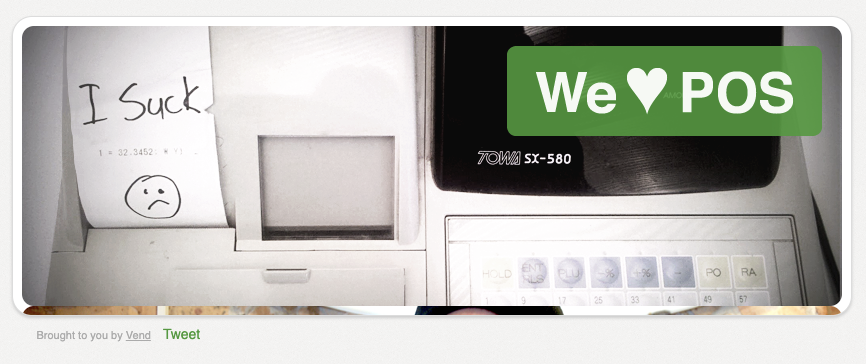
Fortunately it was a non-binding referendum so in the end I convinced Vaughan to stump up $5K to let me make a cash register snuff movie. It was a lot of money for us at the time, but a paltry amount to make a startup video, especially when we wanted to compete with the likes of Dollar Shave club and Lonely Sandwich. I convinced my friend Gerard to squeeze us in between making a TV show and movie, and he convinced some actual talent, and one of our customers let us use their store, and that’s how we ended up throwing a 10kg till off a 5 story carpark in central Auckland (10 points if you can guess who is the voice of Steve).
Sure, we smashed a lot of cash registers after Steve (I mean a LOT), but the underlying principles of the Vend brand was to be ourselves, have fun, and JFDI(Y). I probably made the first half dozen or so videos at Vend on an SLR and iMovie. But like everything at Vend, we could only scale by convincing smarter people to come on the journey too. We attracted people like Simon Pound, who convinced Sally Tran to completely deconstruct the startup video format. We even tried to have fun with arguably the most boring format of video in tech history, the knowledgebase how-to-video (kudos to Strahan for wearing a tin foil and dressing in drag… it seemed like a good idea at the time).
By the end of 2011, as we struggled to keep up with the growth, we rounded out our small team by bringing on board someone who actually knew how to sell, and more importantly, build a sales team and culture. Jean-Christophe Taunay-Bucalo (or JC for short, and not the only double-double-barrel Frenchman to join Vend either) joined as head of sales. He accelerated our sales in the years that followed, he helped level up our systems, capability and overall professionalism, as we exited our first wild year as a startup, and got ready to scale up. I still remember the turning point when, in Dec 2011, JC presented a “Business Case for Implementing Salesforce CRM”. This was the first time anyone at Vend had used PowerPoint. Vaughan and I had to kick each other under the table to stop from giggling. But damn did he sell us on Salesforce. (If I’m honest, JC could have sold us a second-hand fax photocopier he smelled so good).
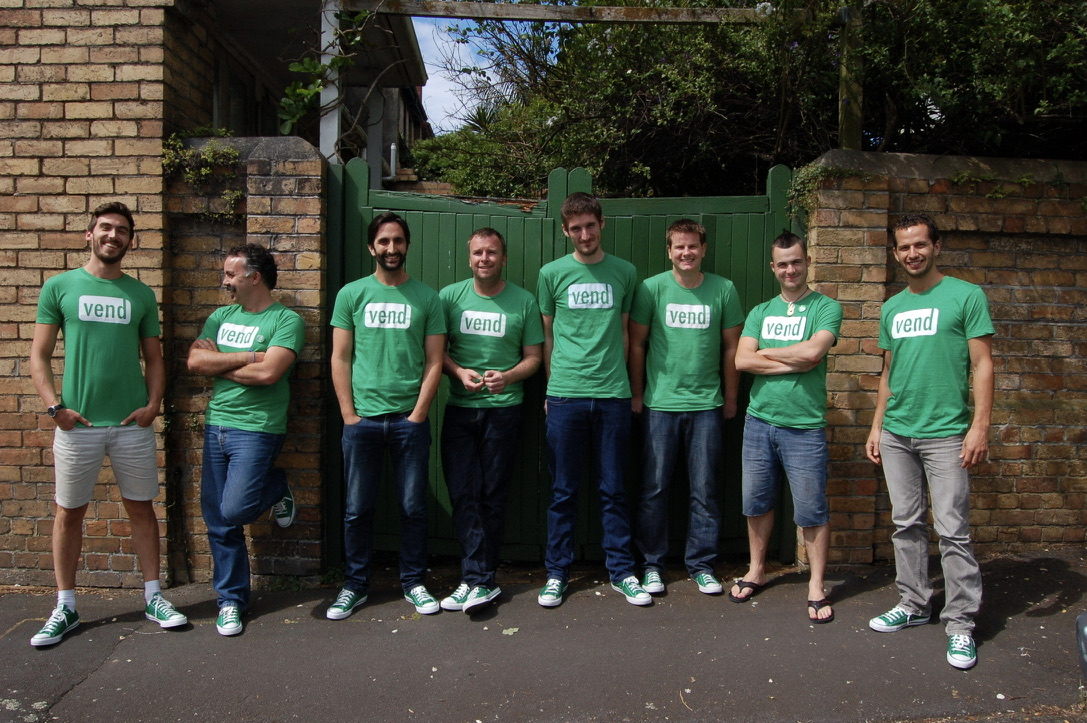
Here is some of the team at the end of 2011, notably absent from the photo is Kara, Morgan, Amiria, Mel, Lauren and Steve. Our own dance party of first and early followers. We’ve spread out to different parts of the world and the tech industry since, but we’re all still friends. One of them is even my brother in law. But I’ll leave the rest of that story to whoever follows me next.